

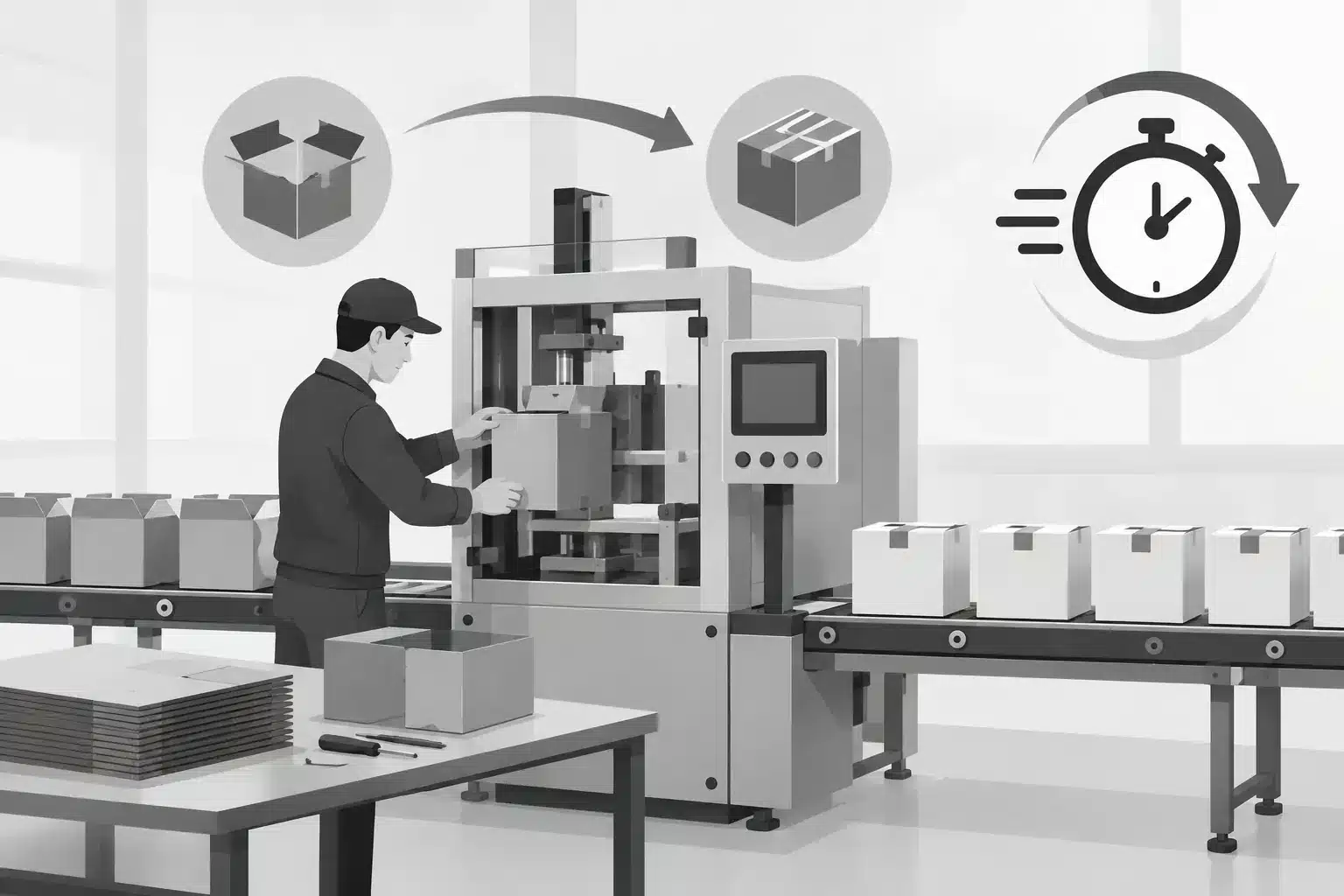
A cartoner that runs well for one SKU but takes an hour to change for the next can quietly limit the output of the entire packaging line. Cartoner changeover time affects more than labor minutes. It influences schedule flexibility, line efficiency, product availability, waste, and the real capacity available to production.
For plants running frequent carton sizes, product counts, or leaflet formats, the best machine is not always the cartoner with the highest published speed. It is the machine that can repeatably move from one approved format to the next without extended adjustment, carton damage, or downstream disruption.
What Determines Cartoner Changeover Time?
Changeover time begins when the last acceptable package from the prior run leaves the machine and ends when the next SKU is producing acceptable, verified packages at operating speed. That definition matters. A tooling swap that takes 15 minutes is not a 15-minute changeover if the machine needs another 25 minutes of tuning before cartons are properly erected, loaded, closed, and coded.
The largest factors are usually the difference between formats, the cartoner design, the condition of the machine, and the discipline of the changeover process. A minor change in carton length may require only a few guide adjustments. Moving from a tuck carton to a larger glued carton, changing product orientation, or adding a leaflet can require substantially more work.
Horizontal and vertical cartoners also have different changeover demands. A horizontal intermittent-motion cartoner handling pouches, trays, or flow-wrapped products may need adjustment at the infeed, product bucket chain, carton magazine, transfer section, closing station, and discharge. A vertical cartoner may place more emphasis on product feed, carton opening, and top-close tooling. Neither design is automatically faster to change. The answer depends on the application and format range.
Start With the Format Family, Not the Nameplate Speed
Before comparing machines, document the carton and product formats the line must run. This is the practical starting point for reducing cartoner changeover time. A cartoner purchased for one narrow format range may be inexpensive and mechanically sound, yet become costly when production expands to a second or third package family.
Record carton length, width, and depth; board style; closure type; product dimensions; product orientation; count per carton; insert requirements; and the required speed for each SKU. Also identify which dimensions change most often. If carton depth and product count change every day, those adjustments deserve more attention than a carton length change that occurs twice a year.
Format families are useful because they expose where a common setup is realistic. Similar cartons may share product buckets, flight spacing, magazine guides, and closing components. Dissimilar cartons may require dedicated change parts. A plant that groups production around compatible families can often reduce adjustments without purchasing new equipment.
There is a trade-off. A highly flexible cartoner can accommodate a broad range of packages, but additional adjustment points and tooling can increase operator complexity. A simpler dedicated-format machine may change quickly within its range but offer little room for future products. The right choice follows the production plan, not a general claim of flexibility.
Look Closely at Tooling and Adjustment Design
Change parts are not a minor detail. They often determine whether a format change is controlled and repeatable or dependent on an experienced operator making small corrections by feel.
For a given format, common change components can include carton magazine guides, pocket or bucket tooling, product guides, flights, carton lugs, folding rails, tucker components, glue-system settings, and discharge guides. Some machines use hand tools and fixed fasteners at several stations. Others use handwheels, scales, indexed settings, quick-release clamps, or recipe-driven servo positions.
Manual adjustment is not necessarily a reason to reject a used cartoner. Well-built mechanical equipment from established manufacturers can be dependable and straightforward to maintain. But a manual machine should be evaluated honestly against the line’s SKU frequency and available labor. If the plant runs long campaigns, a 35-minute documented changeover may be entirely acceptable. If it runs eight short batches per shift, that same machine can become a constraint.
Ask whether change parts are included for every required format. If they are not, determine whether drawings, samples, or existing tooling can be used to produce what is missing. Used equipment is often offered with the tooling installed for its previous application, not with a complete set for a buyer’s product range.
Measure the Full Changeover, Including Restart Losses
A reliable baseline should separate hands-on change time from restart and stabilization time. This reveals whether the problem is physical adjustment, material presentation, machine condition, or operating procedure.
Track the sequence from the last good package through line clearance, removal of prior materials, tooling changes, settings adjustments, carton loading, product loading, first-package inspection, and sustained production at target speed. Record the reason for every delay. A short video review of several actual changes can be more useful than an estimated changeover time taken from a specification sheet.
Pay special attention to recurring restart losses. Carton magazine feeding problems, poorly adjusted suction cups, inconsistent blanks, product transfer timing, glue application, and sensor positioning can all turn a nominally quick format change into a slow one. If operators consistently make the same corrections after every setup, those settings should be documented, marked, or engineered out.
A practical changeover standard should include the approved setting values, the correct tooling identification, a sequence of adjustments, quality checks, and the first acceptable carton criteria. It should also state which tasks can be completed while the prior run is still operating. Preparing cartons, leaflets, labels, tools, and verified change parts in advance reduces downtime without compromising line clearance requirements.
Evaluate Used Cartoners for Changeover Capability
When sourcing used equipment, published specifications are only part of the decision. A cartoner can have the right speed rating and carton range on paper while missing the hardware, controls, or condition needed to support efficient changeovers.
Evaluate the machine in the context of the actual application. Confirm its previous products, carton styles, package orientation, closing method, and infeed configuration. Review the available change parts and identify their condition. Examine wear at adjustment points, guides, rails, chains, bearings, vacuum components, and carton handling sections. Excess play in mechanical assemblies may not stop a machine from running, but it can make repeatable setup difficult.
Controls matter as well. A machine with clear mechanical scales and documented settings may be easier to return to a known format than a poorly documented machine with more automation. Where servo axes and recipe management are present, verify that recipes can be accessed, backed up, and matched to the intended formats. Check whether electrical documentation, manuals, and spare parts information are available.
For buyers in the United States and Canada, sourcing through a packaging machinery specialist can reduce uncertainty around these details. Mectec Packaging Machinery evaluates used equipment for real production requirements, helping buyers assess more than the basic machine category and capacity claim.
Improve the Process Before Replacing the Machine
Not every long changeover requires a new cartoner. Many gains come from better preparation, clearer standards, and a closer match between the schedule and the machine’s format capability.
Start by staging approved materials and change parts before the line stops. Assign one clearly accountable operator for the change and one person for quality release where appropriate. Mark recurring mechanical positions, label tooling by format, and store components together rather than searching for parts at the start of each job. Where safe and permitted, move external tasks such as carton preparation, leaflet loading, and tool staging outside the machine downtime window.
Then review the schedule. Running compatible formats together may reduce the number of major changeovers. This can lower lost time, but it must be balanced against inventory levels, product freshness, and customer demand. A schedule optimized only for long runs can create other operational problems.
Finally, distinguish between a training issue and a machine limitation. If one trained operator consistently completes a stable change in 20 minutes and others need 45, the process needs better standardization. If every operator faces repeated tuning because format components do not fit, cartons vary, or the machine was never designed for the range, the equipment or tooling needs attention.
The useful target is not the shortest possible change on a stopwatch. It is a repeatable changeover that returns the cartoner to safe, verified production with predictable labor and minimal rejected packaging. That is the standard worth using when improving an existing line or selecting the next used cartoner.