

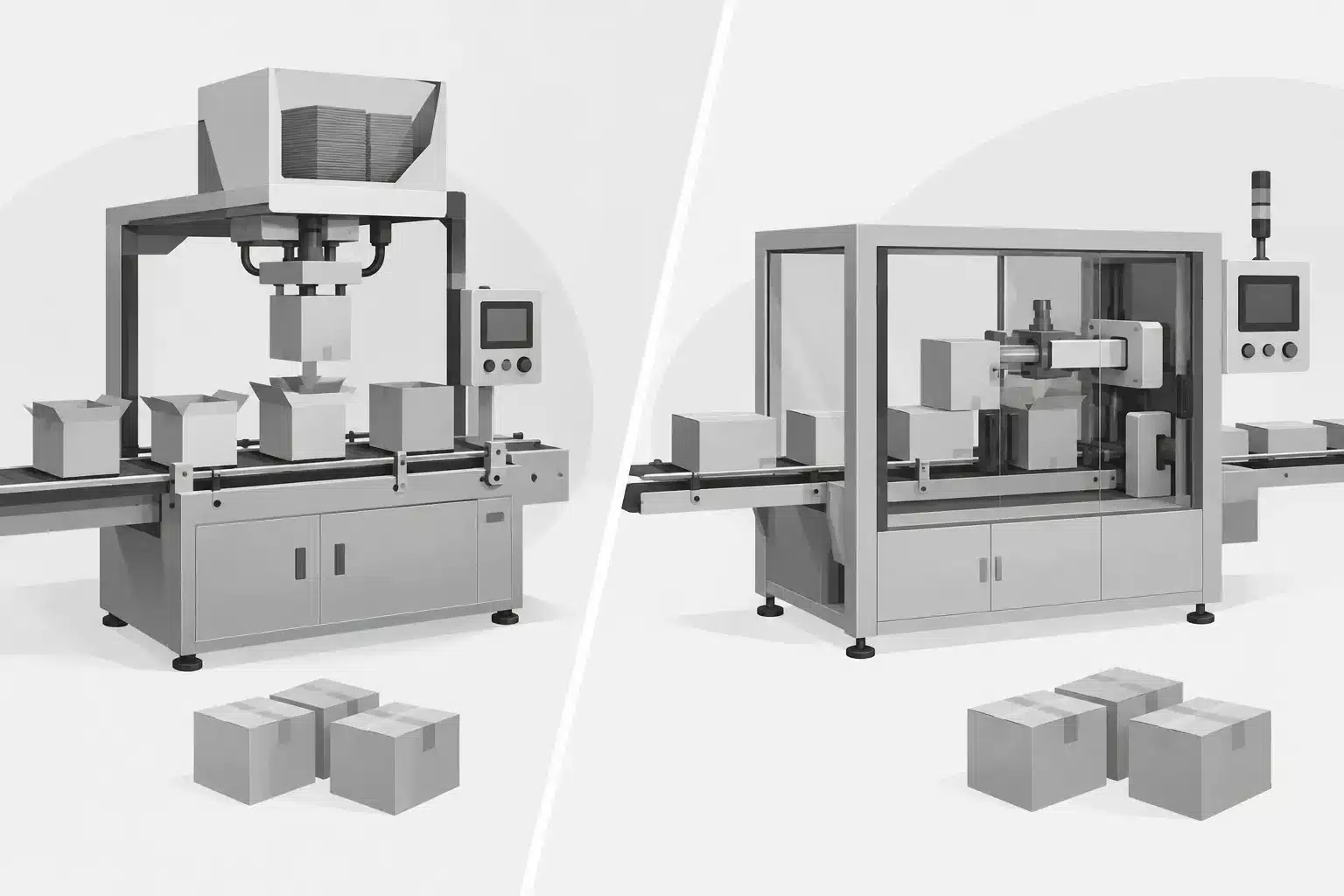
A cartoner can meet the stated speed requirement and still be the wrong machine for the line. The deciding issue is usually how the product must enter the carton, how it behaves during handling, and what happens at the next machine. In the topload versus sideload cartoners decision, product stability, carton geometry, changeover frequency, and available floor space matter more than a single nameplate speed.
For plants purchasing used equipment, the choice also affects what must be inspected before purchase. A proven cartoner from CAM, Langen, ADCO, or another established builder can offer excellent value, but only if its product handling system, carton range, controls, and guarding suit the application.
Topload Versus Sideload Cartoners: The Core Difference
A topload cartoner loads product through the top of an erected carton. The carton is generally carried open through the machine while the product is lowered or placed into it. After loading, the top flaps are closed and sealed. This configuration is often referred to as vertical cartoning, although individual machine layouts vary.
A sideload cartoner loads product horizontally through an open carton end. Products are collated, positioned, and pushed into the carton from the side. The end flaps are then closed and sealed. Sideload machines are commonly associated with horizontal end-load cartons and applications where product orientation is controlled before insertion.
The distinction sounds simple, but it changes the entire handling approach. A sideload system depends on accurate product timing and a controlled horizontal transfer. A topload system depends on getting the product over the carton opening without damaging it, losing orientation, or slowing the loading cycle.
Neither design is automatically better. The right choice is the one that handles the actual product pack consistently, at the required output, with realistic changeover and maintenance demands.
Start With Product Behavior
Product behavior should lead the specification. Carton style comes next.
Topload cartoners are often a practical fit for products that do not move cleanly through a horizontal pusher arrangement. Flexible pouches, bags, unstable multipacks, loose components, and certain bottles or containers can be easier to place from above. Gravity can assist the loading motion, and the product may require less side pressure during insertion.
That does not mean every flexible product belongs in a top-load system. A light pouch may bridge across a carton opening, catch on a flap, or require a loader, funnel, bucket, or flighted transfer to enter reliably. Product presentation remains critical. If pouches arrive inconsistently from an upstream bagger or conveyor, the cartoner cannot correct every issue downstream.
Sideload cartoners are often well suited to rigid, consistently oriented products. Blister cards, flow-wrapped bars, tubes, trays, vials, bottles, and small assembled consumer goods are common examples. When products can be collated in a lane and pushed as a controlled group, sideloading can provide repeatable insertion at high output.
The product must tolerate the loading force. Fragile items, packages with protruding features, or products prone to scuffing may need specialized pushers, guides, or accumulation control. A cartoner that runs empty cartons smoothly may still damage product when production conditions become less than ideal.
Carton Design Can Eliminate Options Early
Carton geometry often narrows the choice before a machine is selected. Topload cartoners are typically used with cartons that open at the top. This can suit display-ready configurations, multipacks, and products that need to be placed vertically into the pack.
Sideload cartoners generally use end-load cartons. They work well for traditional folding cartons containing products arranged in a horizontal line or stack. The machine can form, hold, load, and close these cartons in a defined direction, which supports predictable transfer into case packing or other downstream equipment.
Measure more than length, width, and height. Buyers should confirm the carton blank range, board grade, flap configuration, tuck or glue closure method, and required carton squareness. A machine may accommodate the nominal carton dimensions but struggle with a heavier board, a narrow depth, or a carton that is difficult to erect consistently.
Carton quality also matters. Used cartoners are frequently blamed for issues caused by variable blanks. Poor scoring, warped blanks, inconsistent glue seams, or out-of-spec dimensions can produce opening and closing faults on either style of machine. Test cartons should represent the material used in normal production, not only ideal samples.
Speed Is a System Requirement, Not a Cartoner Number
Both topload and sideload cartoners are available in intermittent and continuous-motion designs. Either can be configured for modest production rates or high-throughput lines. The meaningful question is whether the complete system can sustain the target rate.
A sideload cartoner may have a strong mechanical speed rating, but the line can still be limited by product collation, leaflet feeding, coding, checkweighing, or case packing. Similarly, a top-load cartoner may have sufficient cycles per minute, but upstream product spacing or loading-head travel can set the practical output.
For multipacks, calculate output in cartons per minute and products per minute. A machine running 80 cartons per minute with four products per carton must receive, orient, and load 320 products per minute without starved cartons or excess accumulation. That requirement affects conveyors, product infeed design, and controls integration.
Footprint is another practical constraint. Sideload lines may need space for product accumulation, lane formation, and a horizontal loading section. Topload machines may need overhead clearance or room for loaders, product buckets, and access around the carton-loading zone. A compact machine is not useful if maintenance access is restricted or operators cannot safely clear a routine jam.
Changeover and Operating Reality
Plants running one carton size for long campaigns may prioritize output and mechanical simplicity. Plants running frequent SKUs need a more careful look at changeover.
Review the actual adjustments required for each format. These may include carton magazine rails, forming tools, product guides, pushers, infeed flights, loading heads, glue positions, and discharge rails. Servo-driven adjustment can reduce manual work, but it also introduces components and control functions that must be understood and supported.
Ask for the available change parts, drawings, manuals, and electrical documentation. A used cartoner with the right core machine but no format tooling can become a costly project. The same is true when a machine was previously configured for cartons outside the required size range.
Operator access matters as much as published changeover time. If adjustments are difficult to reach, format changes take longer and setup errors become more likely. Maintenance teams should inspect wear points such as carton transport chains, vacuum systems, cam followers, bearings, glue equipment, pneumatic components, and guarding interlocks.
What to Check When Buying a Used Cartoner
Used cartoning equipment can be a disciplined capital decision when the machine is evaluated against the intended application. Start with the product, carton, rate, closure method, and available layout. Then verify that the machine configuration supports those requirements.
A useful evaluation should confirm the machine’s age, operating history, condition, control platform, electrical specifications, and documentation. It should also establish whether the original product infeed and discharge equipment are included. Cartoners are integrated machines. Missing infeeds, feeders, or discharge components can affect both cost and commissioning time.
Whenever possible, review the machine operating and inspect its carton handling sequence. Watch for consistent blank pickup, positive carton opening, accurate product placement, flap control, glue application or tuck closure, and clean discharge. If the equipment cannot be run, the inspection should be more conservative and the scope of refurbishment should be defined clearly.
Mectec Packaging Machinery sources and evaluates used cartoners against the buyer’s production needs rather than treating every available machine as interchangeable. That matters when a line requires a particular brand, carton range, capacity, or product-handling arrangement.
Choose the Machine That Reduces Line Risk
Choose a topload cartoner when the product benefits from vertical placement, when side loading could cause damage or instability, or when the carton and pack presentation are built around top access. Choose a sideload cartoner when products can be accurately collated and inserted horizontally into end-load cartons at the required rate.
The final decision should account for more than current production. Consider the next product launch, the likely carton range, available change parts, technician familiarity, and the equipment that feeds and follows the cartoner. The best purchase is not simply a capable used machine. It is a machine that fits the line well enough to keep producing when schedules get tight.