

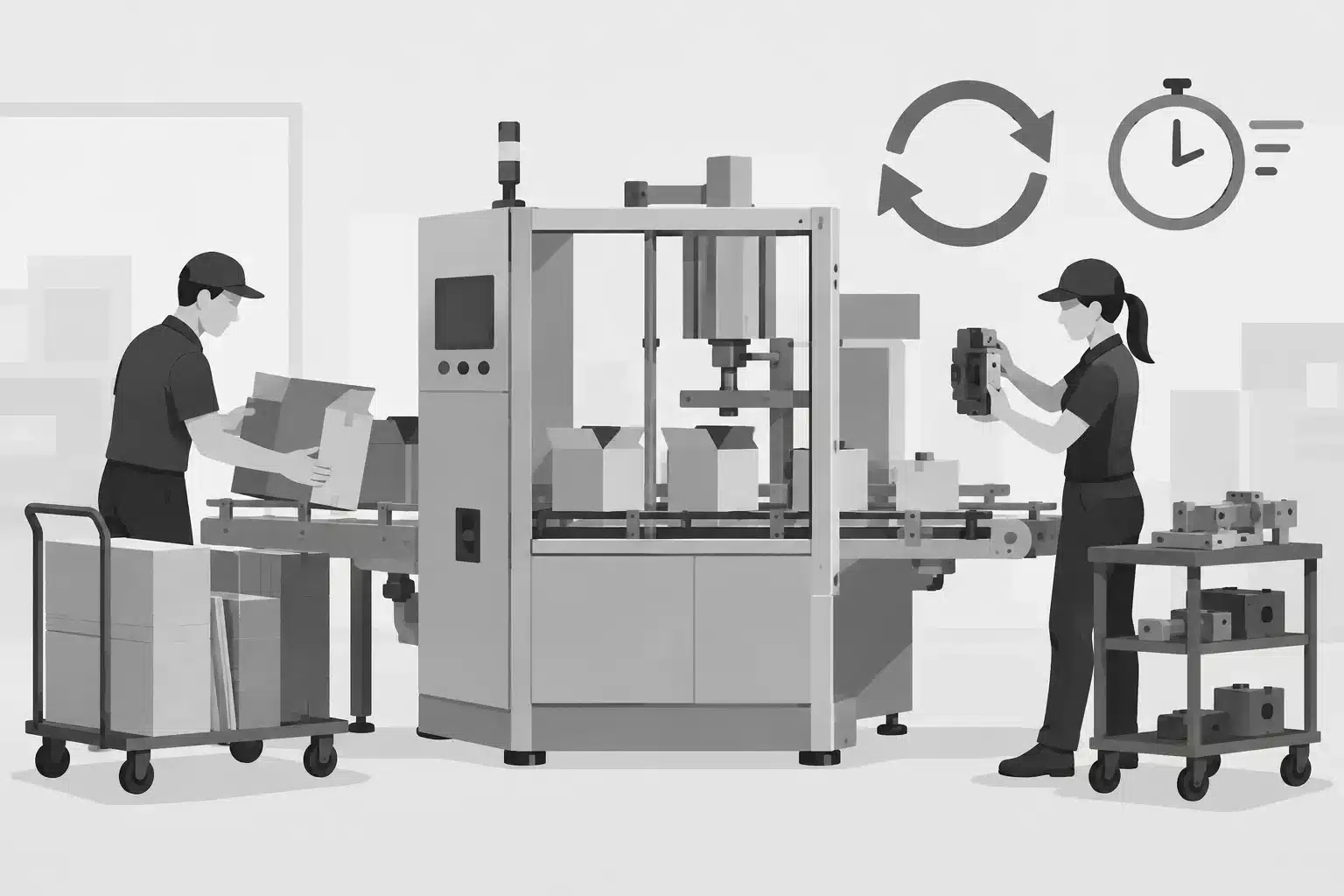
A cartoner that runs well at speed can still limit line output if every format change takes too long, requires repeated adjustments, or depends on one experienced operator. Knowing how to optimize cartoner changeovers means treating the changeover as a controlled production process, not a pause between production runs.
For plants handling multiple carton sizes, pack counts, inserts, or product configurations, the opportunity is significant. Cutting 20 minutes from a changeover that occurs several times per week can recover meaningful capacity without adding another shift or buying a higher-speed machine. The goal is not simply a faster adjustment. It is a repeatable restart that produces acceptable cartons quickly and safely.
Start With the Real Changeover Time
Most teams measure changeover time from the last good carton of the prior run to the first good carton of the next run. That is the right starting point, but the number should be broken into its actual components. A 45-minute changeover may include 10 minutes of cleaning, 15 minutes locating or installing change parts, 10 minutes of mechanical adjustments, and 10 minutes of trial runs and quality corrections.
Those categories require different fixes. Better operator discipline will not solve missing format parts. A new parts cart will not correct worn carton feed components. Before changing the process, observe several changeovers across different shifts and product formats. Record each action, who performs it, whether the machine is stopped, and what causes the first rejected cartons.
The first objective is to separate internal work from external work. Internal work can only happen while the cartoner is stopped, such as removing installed guides or changing a tooling set. External work can be completed while the machine is still running, including bringing the next carton blanks, checking product supply, staging inserts, verifying lot code requirements, and preparing the correct change parts.
A large share of avoidable downtime sits in that external work. If operators begin searching for rails, belts, funnels, or manuals after the line has stopped, the process was already behind schedule.
Standardize Each Carton Format
Cartoner changeovers become unpredictable when settings live in an operator’s memory. Every recurring format needs a documented setup standard that identifies the exact parts, machine positions, product orientation, carton blank specification, and inspection requirements.
A useful format package does more than list a part number. It includes photos of installed change parts, clearly marked adjustment points, machine settings, torque or clamp requirements where relevant, and a record of the first-pass quality checks. For intermittent-motion and continuous-motion cartoners alike, small differences in carton dimensions, board stiffness, product stack height, or leaflet fold can affect transfer timing and carton closure quality.
Use a simple, controlled naming system for formats. The production order, carton blank, change-part kit, setup sheet, and recipe file should all use the same format identifier. This avoids a common problem: the correct carton is staged, but the machine receives a similar-looking guide set or an outdated recipe.
For servo-driven equipment, stored recipes can reduce manual adjustment. They do not eliminate verification. Operators still need to confirm the physical tooling, carton magazine setup, glue or tuck closure performance, product loading, coding, and reject function. Recipes improve repeatability when the mechanical condition of the machine supports them.
Treat change parts as production assets
Change parts are often stored as miscellaneous accessories. That approach creates delays and raises the risk of using worn or mismatched components. Keep each format kit complete, labeled, and located near the machine or in a controlled tooling area.
Inspect rails, carton pockets, pushers, flights, product guides, magazine components, and closure tooling on a planned schedule. Worn parts can turn a nominally quick format change into extended troubleshooting. They may also cause intermittent jams that are difficult to trace once the line is running.
If the plant uses several similar cartoners, do not assume parts are interchangeable. Confirm machine model, serial range, pitch, frame configuration, and format dimensions. Established machines from manufacturers such as CAM, ADCO, and Langen can offer strong service life, but the correct configuration still matters.
Reduce Adjustment Points Where It Makes Sense
Manual handwheel adjustments are not inherently a problem. They become a problem when they are unmarked, difficult to access, or dependent on judgment rather than a defined setting. Clearly indexed scales, color-coded positions, positive stops, and labeled handwheels reduce setup variation without requiring a full machine rebuild.
Look first at adjustments that affect carton feeding, product infeed, carton opening, loading, and closure. These are the areas most likely to create startup rejects. If an adjustment must be made on every format change, make it visible and measurable. If it is rarely changed, confirm whether it can be fixed in a standard position.
Quick-release hardware can save time, but it is not always the right answer. It should be used where it preserves repeatable positioning and does not compromise guarding, rigidity, or sanitation requirements. In food, pharmaceutical, and personal-care applications, any modification must also support cleaning procedures and validation expectations.
The best improvement is usually modest: a missing scale added to a guide rail, an indexed locator replacing a subjective position, or a dedicated fixture that sets a component consistently. Small mechanical improvements often outperform a complicated automation project.
Build a Changeover Sequence Operators Can Run
A documented sequence needs to reflect the machine on the floor, not an idealized procedure written from a manual. Involve the operators and maintenance technicians who perform the work. They know which components stick, which guards take time to remove, and where the setup commonly goes wrong.
The sequence should establish a clear handoff from the outgoing to the incoming product. Before the prior run ends, the next product, carton blanks, inserts, coding materials, and verified change-part kit should be staged. Once the machine stops, the operator completes the defined mechanical tasks in order, while a second qualified person can prepare downstream equipment or complete line clearance checks where staffing permits.
Two people do not automatically make a changeover faster. They help when tasks can occur in parallel without crowding the machine or creating safety risks. On a compact line, one trained operator following a disciplined sequence may be more effective than two people working around each other.
Training should focus on the reasons behind critical settings, not just the order of actions. An operator who understands how carton magazine pressure affects blank separation can diagnose a feed issue faster than someone who only knows the target setting. Cross-training also prevents changeover performance from depending on a single shift lead.
Verify Startup Before Chasing Full Speed
The first goal after a format change is stable, compliant production. Running immediately at maximum speed can create a pile of crushed cartons, improperly loaded products, or poor closures that obscures the actual setup issue.
Start at a controlled speed and verify carton opening, product placement, leaflet or insert handling, closure integrity, code placement, reject function, and downstream transfer. Once several consecutive cartons meet specification, increase speed in planned increments. This approach may appear slower for the first few minutes, but it reduces total time lost to repeated stops and rework.
Track first-pass yield after each changeover. A short mechanical changeover followed by 30 minutes of rejects is not an optimized result. The strongest measure combines downtime, startup waste, labor required, and time to sustained rated output.
Know When the Cartoner Is the Limiting Factor
Not every changeover problem is procedural. A cartoner designed for a narrow format range may require extensive manual work when asked to handle widely different carton dimensions or product configurations. Missing change parts, obsolete controls, damaged tooling, and limited format documentation can also make a machine expensive to operate despite a low purchase price.
When evaluating a used cartoner, confirm the required carton size range, product dimensions, closure style, infeed arrangement, available change parts, electrical configuration, controls, and condition of high-wear assemblies. Ask for production history where available and review whether the machine has run applications comparable to yours. A machine that is proven on the right format can be a practical acquisition. A machine that needs extensive adaptation can erase the expected savings.
Mectec Packaging Machinery helps buyers assess used cartoners against real packaging-line requirements, including format range, capacity, available tooling, and integration needs. The right machine is not simply one that can form and close a carton. It is one your team can change over, maintain, and run reliably.
A disciplined changeover process makes existing equipment more productive. It also gives you a sharper standard for your next equipment purchase: fewer unknowns, defined format requirements, and a clear view of what the line must achieve every shift.