

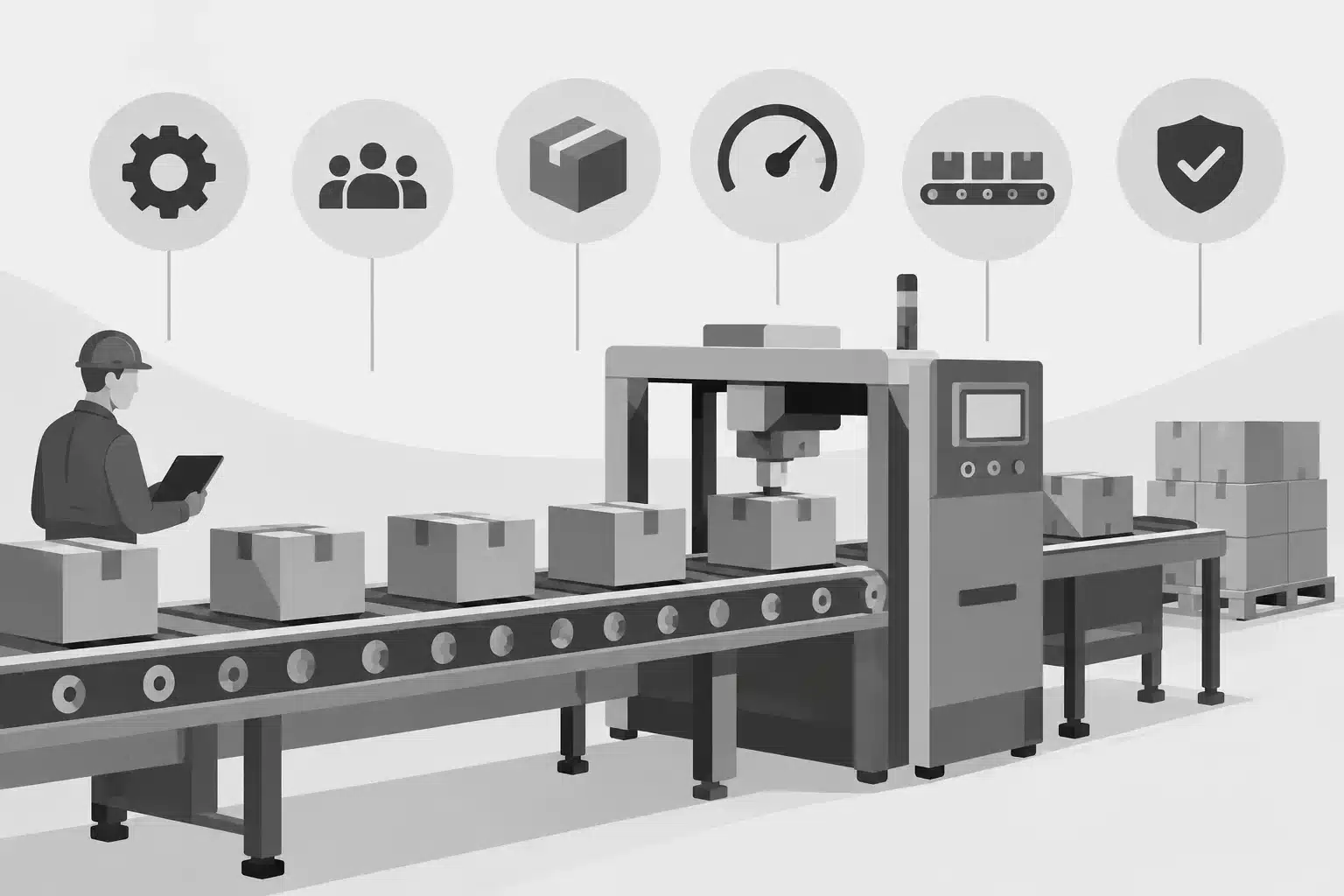
A cartoner rated for 120 cartons per minute may run reliably at 85. A filler capable of 200 containers per minute may be held back by a labeler, case packer, or a manual packing station. That gap is the practical answer to what affects packaging line speed: output is set by the whole system, not the nameplate speed of one machine.
For plant managers and equipment buyers, the goal is not simply to specify the fastest machine. It is to achieve a stable, repeatable rate with acceptable rejects, manageable labor, and enough recovery capacity to keep production on plan. A packaging line that runs slightly below its maximum rating but avoids frequent stops will usually produce more saleable product over a shift.
What Affects Packaging Line Speed Most?
The slowest required process establishes the line’s ceiling. In a simple line, that may be a filler, cartoner, shrink wrapper, tray former, case erector, or palletizing operation. In a more complex line, the constraint can shift by product, package format, shift crew, or production run length.
Machine speeds stated by manufacturers are useful reference points, but they are often based on favorable conditions: a stable product supply, a single package format, properly matched conveyors, trained operators, and no interruptions. Actual production speed needs to account for startup, brief stops, rejected packs, changeovers, cleaning, and planned maintenance.
A useful distinction is between machine cycle speed and sustained line speed. Cycle speed is what a machine can process under ideal conditions. Sustained speed is what the line delivers hour after hour. Procurement decisions should be based on sustained output at the products and formats that matter most.
The Bottleneck Is Often Outside the Main Machine
A packaging machine cannot make up for poor flow before or after it. If an infeed conveyor starves a cartoner, the cartoner waits. If a downstream case packer backs up, the cartoner must slow or stop. Small interruptions accumulate quickly, especially on high-speed lines.
Product accumulation provides a buffer between processes, but it is not a cure for a mismatched line. Accumulation must be sized for normal disturbances and arranged so it does not damage product, create orientation issues, or make cleaning difficult. Flexible packages, unstable bottles, and delicate cartons each require different conveyor control and transfer design.
Discharge conditions deserve the same attention as product feed. A fast shrink wrapper feeding an undersized manual packing area will only transfer the constraint. Likewise, a case erector that cannot reliably keep up will restrict every upstream machine, regardless of their rated capacities.
Speed Matching Matters More Than Peak Speed
Machines do not need identical nameplate ratings. They need compatible operating ranges. A 100-per-minute cartoner may work well with an 85-per-minute filler if it has enough buffer and recovery capability. It is a poor fit if the filler routinely surges above that rate or if the cartoner needs frequent stops to clear product gaps.
When reviewing used equipment, confirm the machine’s demonstrated speed at your package dimensions, product characteristics, and pack pattern. A recognized brand and an attractive rated speed are positive signs, but they do not replace application fit.
Product and Package Variables Change the Real Rate
The product itself frequently sets the practical limit. Powders may settle inconsistently. Viscous products may fill slowly. Frozen foods can bridge or vary in size. Bottles can be unstable, and flexible pouches may not present consistently to a cartoner or case packer. Higher speed increases the consequences of those variations.
Package design has the same effect. Carton board stiffness, glue pattern, bottle geometry, cap type, film gauge, label material, and tray dimensions all influence handling. Minor variation in supplied packaging materials can create jams, poor seals, skewed labels, or rejected cases that reduce sustained output.
Format complexity matters as well. A line running one bottle size in a standard case may achieve a high stable rate. The same line may run much slower when switching among multipacks, promotional sleeves, mixed cases, or short-run formats. There is no universal speed number that applies across every SKU.
Changeovers Can Reduce Capacity More Than Runtime Speed
A line can look fast on paper and still miss its weekly target because it spends too much time changing formats. Short production runs, frequent SKU changes, and multiple pack configurations make changeover performance a capacity issue, not just a labor issue.
Change parts, servo recipes, adjustable guides, tool-less settings, and clear setup documentation can reduce the loss. So can a sensible production schedule that groups compatible formats where possible. The trade-off is straightforward: more flexibility may mean a lower maximum speed or a more involved machine configuration.
Before buying a cartoner, sleever, case erector, tray former, or shrink system, identify every format it must handle. Confirm the range of widths, heights, lengths, and pack patterns. Ask which change parts are included, which are available, and how adjustments are made. A machine that fits today’s primary carton but cannot support the next planned format can become an expensive constraint.
Equipment Condition and Controls Affect Repeatability
Used packaging machinery can provide strong value, but condition affects attainable speed. Wear in chains, bearings, timing components, belts, vacuum systems, sealing jaws, and product-handling assemblies can show up as intermittent faults long before a machine stops completely. These faults are often responsible for repeated micro-stops that erode output.
Controls condition matters too. A machine may be mechanically sound but difficult to support if its PLC, drives, safety system, or HMI are obsolete or poorly documented. Available spares, electrical compatibility, guarding, and integration requirements should be reviewed before purchase.
For critical applications, evaluate a machine under power when possible. Confirm its operating history, inspect the condition of format parts, and verify that it can be configured for the required application. Mectec Packaging Machinery focuses on sourcing and evaluating proven equipment because a lower purchase price has little value if the machine cannot deliver dependable production.
Operators, Maintenance, and Utilities Set the Daily Pace
A capable line still depends on people and basic operating discipline. Operators need clear standards for replenishing materials, clearing minor jams, checking quality, and escalating faults. Maintenance teams need access to common wear parts and enough planned time to correct developing issues before they become failures.
Compressed air quality, vacuum supply, electrical stability, temperature, and sanitation requirements can also limit speed. A weak vacuum system may cause missed carton picks. Inconsistent air pressure can affect pneumatic actuators and sealers. Washdown environments may require different components and maintenance intervals than dry applications.
The most productive plants track the reason for every stop, even brief ones. A simple review may reveal that a large portion of lost time comes from one recurring carton-feed issue, an unreliable sensor, slow material replenishment, or a downstream transfer point. Correcting that specific issue often produces more capacity than replacing an otherwise suitable machine.
How to Assess Required Line Speed Before You Buy
Start with the required output in saleable units per shift, then work backward. Include planned operating time, expected changeovers, sanitation, breaks, maintenance, and a realistic allowance for minor stops. This produces a required sustained rate, which is more useful than a maximum theoretical rate.
Next, map each operation from product infeed through final case or pallet. Record the current or expected speed, buffer capacity, format range, and known constraints at every stage. Pay close attention to transfer points between machines. That is where speed mismatch and product instability often become visible.
Finally, allow for growth without specifying unnecessary excess capacity. Buying dramatically faster equipment can add cost, complexity, and integration risk. Buying equipment with no recovery margin can leave the line unable to recover after normal stops. The right target depends on demand patterns, SKU mix, staffing, and the consequences of missed production.
A packaging line earns its speed when every machine, material, utility, and operator action supports the next one. Specify for the sustained output you need, verify the application fit, and address the real bottleneck before investing in more speed.