

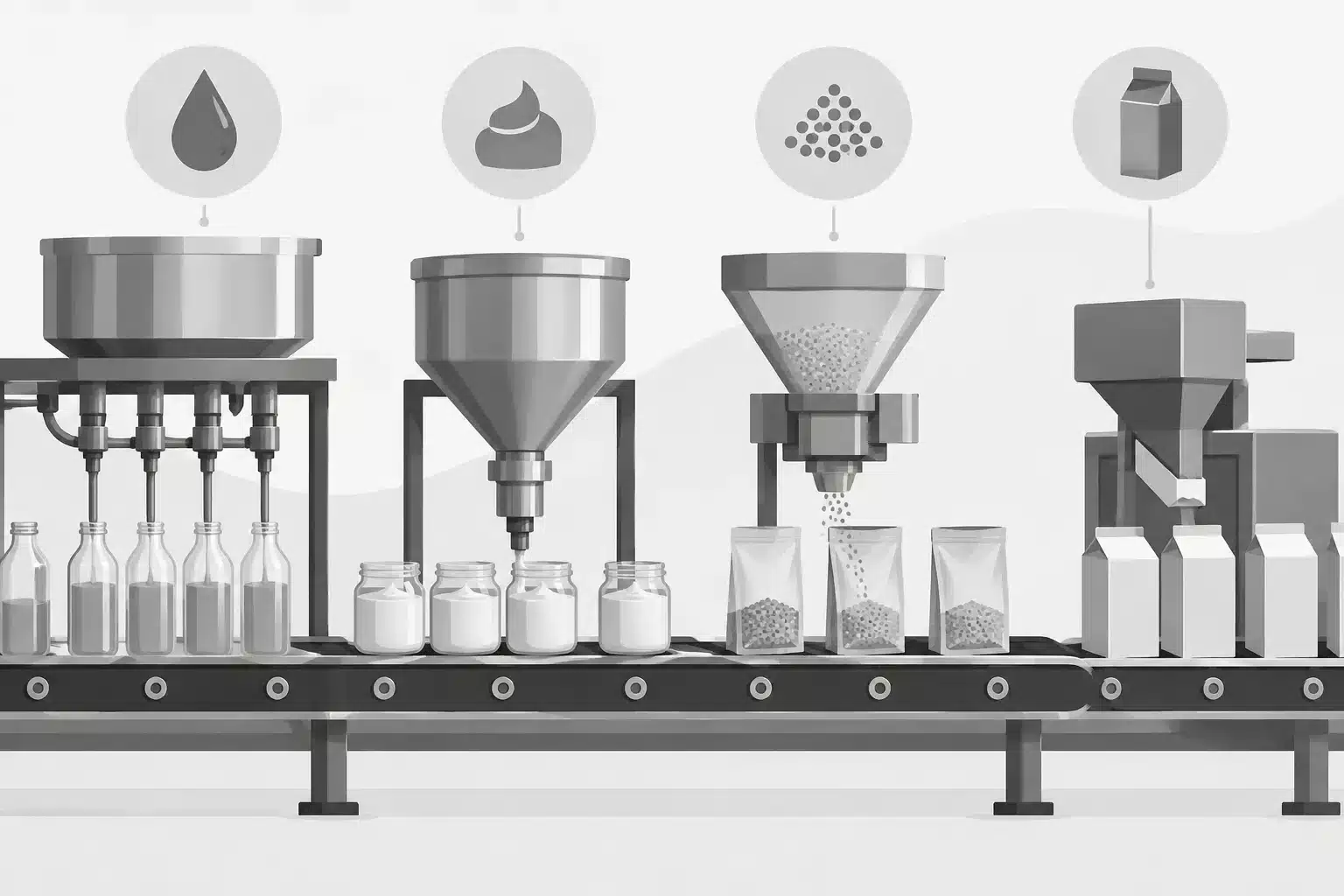
A filler that is wrong for the product rarely fails in an obvious way on day one. It creates small losses instead: inconsistent weights, drips at the capper, excess giveaway, slow changeovers, and operators making constant adjustments. Understanding filler types before buying equipment helps prevent those issues and keeps the packaging line aligned with actual production requirements.
The right choice starts with the product, not the machine’s nameplate speed. Viscosity, particulate size, foaming behavior, fill tolerance, container geometry, sanitation requirements, and available line controls all affect which filling method will perform reliably. A machine that runs well with water may be unsuitable for sauces, powders, or abrasive granules.
Common Filler Types and Where They Fit
Packaging fillers are usually selected by the way they measure and transfer product. Some use time or volume. Others use weight. The differences matter because each approach has limits on accuracy, product handling, and practical operating speed.
Gravity fillers
Gravity fillers use the product’s natural flow through valves into containers. They are commonly used for thin, free-flowing liquids such as water, juices, solvents, and certain cleaning products. With few moving parts in the product path, gravity systems can be straightforward to operate and maintain.
Their limitation is product consistency. Changes in product temperature, viscosity, supply pressure, or tank level can affect fill volume. They are generally a poor fit for thick products, products with large particulates, or applications requiring very tight fill tolerances. For the right liquid, however, a multi-head gravity filler can provide dependable output at a practical cost.
Overflow fillers
Overflow fillers are designed to create a consistent visible fill level. Excess product returns through an overflow port, leaving each bottle filled to the same height. This makes them a common choice for clear bottles of shampoos, beverages, detergents, and other consumer products where shelf appearance is a priority.
They work best with low- to medium-viscosity liquids that can recirculate easily. Foaming products require careful setup, and products with particulates can obstruct the return path. An overflow filler may look simple, but nozzle condition, tank control, bottle positioning, and recovery plumbing all affect results.
Piston fillers
Piston fillers measure a defined volume by drawing product into a cylinder and discharging it through a nozzle. They are widely used for thick, viscous products including sauces, creams, gels, pastes, peanut butter, and cosmetic products. Properly configured piston systems can also handle some products with soft particulates.
For many food and personal-care applications, piston filling provides a useful balance of accuracy and versatility. The trade-off is that seals, cylinders, valves, and product-contact components require regular inspection. Cleaning time can also be significant, particularly when products dry or build up inside the system. A used piston filler should be evaluated for cylinder wear, valve condition, parts availability, and the suitability of its sanitary design.
Pump fillers
Pump fillers move product using gear, lobe, progressive cavity, peristaltic, or other pump styles. They can handle a broad range of viscosities and are often chosen when the product needs controlled, gentle transfer. Pump filling is common in products that are shear-sensitive, contain inclusions, or require a longer transfer distance from the product supply.
Pump selection is central to performance. A gear pump may suit certain oils and creams, while a lobe or progressive cavity pump may be better for heavier food products. Peristaltic pumps can be useful where containment and clean product paths are priorities. Buyers should confirm the pump type, motor and drive controls, hose or seal requirements, and whether the system can achieve the required fill range without sacrificing accuracy.
Auger fillers
Auger fillers use a rotating screw to dispense powders into containers, pouches, bags, or other packages. They are common in spice, coffee, flour, protein powder, pharmaceutical, and chemical applications. Servo-driven auger systems can provide repeatable dosing when the powder’s bulk density remains controlled.
Powders are rarely as simple as they appear. They may bridge, compact, aerate, absorb moisture, or vary in density between batches. Hopper agitation, screw design, dust collection, and refill control often matter as much as the auger itself. A filler sized for a fine free-flowing powder may not perform well with a sticky, cohesive, or highly dusty product.
Net-weight fillers
Net-weight fillers fill containers to a target weight using load cells or scales. They are frequently used for products sold by weight, including bulk foods, granules, pet food, chemicals, and larger liquid formats. A net-weight system can compensate for variations that make volume-based methods less reliable.
These systems are often accurate, but they require stable mechanical setup and good control integration. Vibration from upstream conveyors, inconsistent product feed, or poor scale calibration can reduce repeatability. Net-weight filling can be a strong choice for larger containers or expensive products where giveaway has a direct effect on margin.
Volumetric cup and flow-meter fillers
Volumetric cup fillers dispense a measured volume using cups, pockets, or rotary chambers. They are commonly used for free-flowing dry products such as rice, candy, seeds, snacks, and small granules. They are fast and mechanically proven, but their accuracy depends on consistent bulk density and product behavior.
Flow-meter fillers measure liquid movement through a meter rather than relying on a timed valve or piston stroke. They can be effective for a range of liquids and are often used when electronic controls and recipe flexibility are needed. Their performance depends on meter compatibility with the product, stable flow conditions, and a properly maintained product supply system.
How to Match Filler Types to the Line
Start with the product’s operating behavior under real production conditions. A sample in a lab container does not tell the full story. Consider product temperature at filling, viscosity range, foam, solids, cleaning chemicals, batch variation, and whether the product is pumped from a tank or fed directly from upstream processing.
Next, establish the fill requirement. Is the package sold by volume, by net weight, or by a visible fill level? A clear bottle of shampoo may favor an overflow system because a level appearance matters. A high-value sauce may justify piston or net-weight control to limit giveaway. A bag of seasoning powder may need auger filling with dust management rather than a general-purpose volumetric system.
Then look at package and line constraints. Container diameter, neck opening, package stability, required nozzle travel, capper speed, conveyor height, and available footprint can rule out otherwise suitable equipment. The filler must also communicate effectively with the infeed conveyor, capper, sealer, checkweigher, and reject system. Filling performance is only useful when the rest of the line can keep pace.
Used equipment adds another layer of review. Capacity claims should be tied to the actual product and package, not only the machine’s theoretical maximum. Confirm the number of heads, fill range, available change parts, electrical configuration, controls platform, product-contact materials, and documentation. For sanitary applications, inspect the condition and cleanability of tanks, manifolds, valves, pumps, hoses, and seals.
When a Used Filler Makes Commercial Sense
A proven used filler can reduce capital cost and shorten procurement time, especially when it matches an established package format and production method. Recognized manufacturers often offer an advantage because replacement components, technical knowledge, and integration support may be easier to source than for obscure equipment.
The best value is not always the lowest purchase price. A lower-cost machine can become expensive if it needs extensive reconfiguration, cannot meet sanitation requirements, lacks change parts, or does not fit the line’s controls and conveyor layout. Equipment condition, application fit, and the quality of pre-purchase evaluation carry more weight than a bargain price.
Mectec Packaging Machinery helps buyers identify used fillers based on product characteristics, package format, required output, and line compatibility. That approach is particularly useful when the needed machine is not available as standard inventory and must be sourced to a defined application.
A filling machine should make production more predictable, not give the maintenance team another variable to manage. Define the product, package, tolerance, and operating conditions first. Then select from filler types that have a clear record of handling that application. The result is a more defensible equipment purchase and a line that is easier to run.