

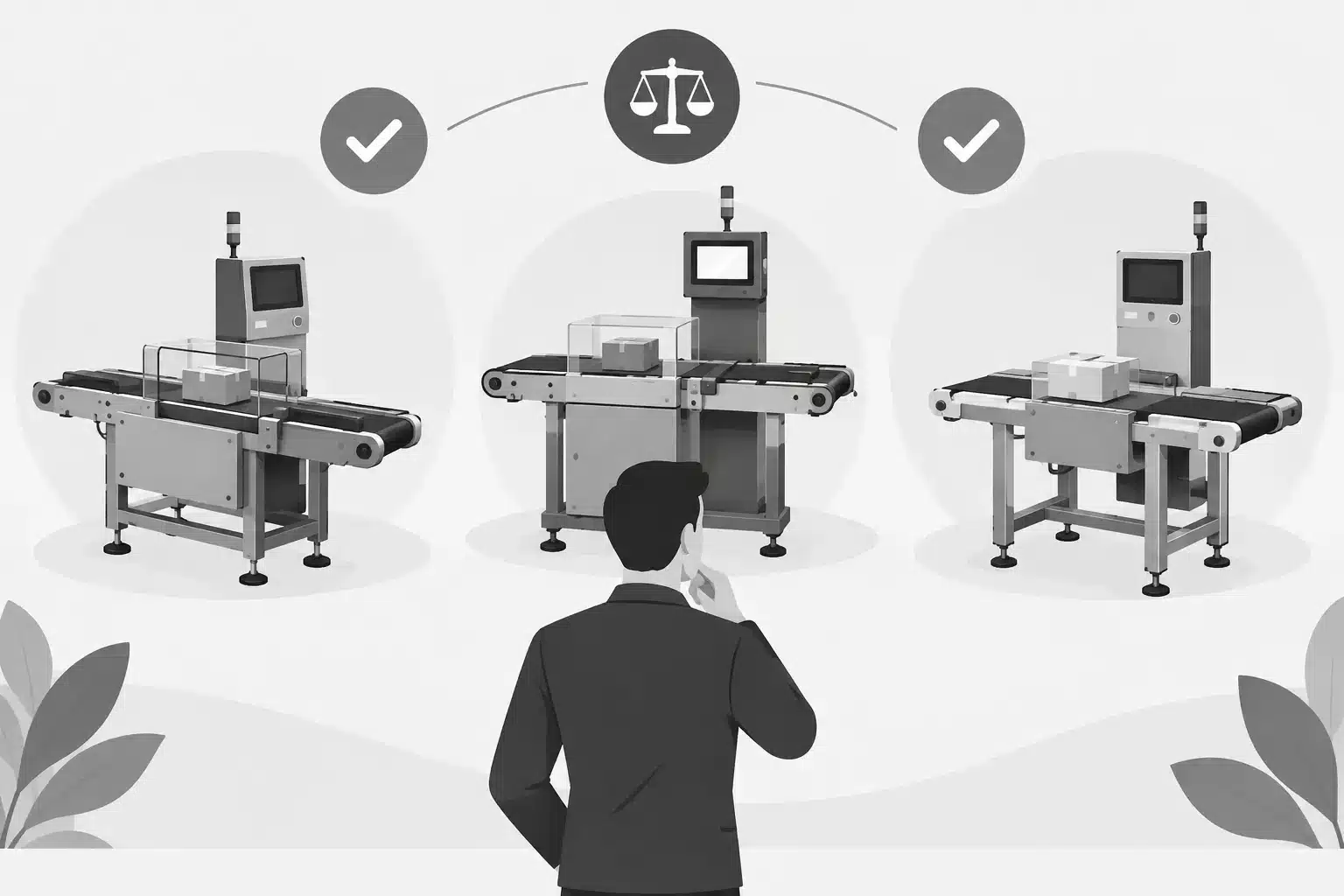
A checkweigher that rejects good product creates as much trouble as one that misses an underweight pack. That is why a useful checkweigher technology comparison starts with the actual product, line speed, and compliance requirement – not a headline accuracy number. For used equipment buyers, the condition and suitability of the complete system matter just as much as the brand or model.
Checkweighers verify product weight while packages move through production. They can support net-content control, detect missing components, reduce giveaway, and provide documented inspection results. But the best technology depends on what is being weighed, how consistently it arrives, and what must happen after an out-of-tolerance result.
Start With the Job the Checkweigher Must Do
A dynamic checkweigher weighs each item in motion. It typically uses an infeed conveyor, a weigh conveyor, an outfeed conveyor, controls, and a reject device. Dynamic systems suit high-volume lines handling pouches, cartons, bottles, trays, jars, and other packaged goods.
A static system weighs an item while it is stopped or held in place. Static weighing is slower, but it can be appropriate for larger cases, drums, and products that cannot pass reliably across a short conveyor. The distinction is simple: dynamic systems protect throughput; static systems favor deliberate measurement of heavier or less stable loads.
The product itself determines much of the specification. A 30-gram snack pouch at 250 packages per minute has different requirements than a 10-pound case at 30 cases per minute. Package dimensions, center of gravity, base stability, spacing, surface friction, and temperature all affect weighing performance. A machine that performs well on one product may be a poor fit for another.
Checkweigher Technology Comparison: The Weighing System
Most industrial dynamic checkweighers use strain-gauge load cells. The weigh conveyor applies force to the load cell, which converts that force into an electrical signal. The controller filters and calculates a weight while the package is in the weigh zone. This is proven, widely serviceable technology and is common across packaging applications.
Strain-gauge systems offer a practical balance of speed, capacity, accuracy, and availability. Their limits are usually not about the basic sensing principle. They arise from vibration, conveyor setup, package transfer, product spacing, electrical noise, and a machine that has not been configured for the application.
Electromagnetic force restoration, often called EMFR, is used in some high-precision checkweighing applications. It can deliver very fine resolution and fast response for lighter products, particularly where tight tolerances and high speeds are required. The trade-off is that this technology can be more sensitive to application conditions and may require more specialized support. It is not automatically the right choice for every line.
For many used-equipment purchases, the practical question is whether the existing weighing platform has the required capacity and resolution for the product range. A system designed for small cartons may not have the capacity for filled jars or multipacks. A heavier-capacity system may handle the load but lack the resolution needed to control giveaway on a lightweight package.
Accuracy, Resolution, and Repeatability Are Different
Buyers often use these terms interchangeably. They should not. Resolution is the smallest displayed weight increment. Accuracy describes how close a reported result is to a known reference. Repeatability indicates whether the machine returns similar results when it weighs comparable packages under consistent conditions.
A system can display very small increments without delivering meaningful production accuracy. Conversely, a checkweigher can be highly effective at identifying process drift even when its displayed resolution is not the smallest available. The relevant measure is repeatable performance on the customer’s actual package at the intended line speed.
Ask for practical test results whenever possible. Product samples, known test weights, and a clear speed target provide a more useful basis for evaluation than a specification sheet alone.
Conveyor Design Controls the Result
The conveyor arrangement is not a secondary detail. It is part of the weighing system. Product must transfer from the infeed to the weigh conveyor and then to the outfeed without bouncing, dragging, tipping, or contacting a guide rail at the wrong moment.
Short weigh conveyors can support faster product flow but leave less time to capture a stable reading. Longer conveyors may help with larger products and slower applications. Belt type, conveyor width, guide rails, side transfer, and accumulation conditions must all match the package.
A bottle, for example, may need timing screws, infeed metering, or specialized guides to ensure stable spacing. A flexible pouch may need a belt surface and transfer geometry that prevent folding or flutter. Cartons often run well when the base is flat and transfers are well aligned, but light cartons can still be affected by air movement or improper guide pressure.
Line vibration deserves close attention. Nearby case erectors, fillers, conveyors, and compressors can introduce disturbances that reduce weighing consistency. Floor condition and machine leveling also matter. A quality used checkweigher should be evaluated for mechanical condition, but final performance still depends on installation and integration at the production site.
Controls, Data, and Reject Verification
The controller determines how usable a checkweigher is on a working line. Operators need straightforward product setup, clear tolerance settings, and access to fault information. Maintenance teams need diagnostics, replacement-part availability, and an electrical architecture they can support.
Older systems may use controls that are reliable but less flexible for reporting or plant-network integration. Newer controls can offer recipe storage, statistical process data, audit trails, remote access capability, and connection to upstream or downstream equipment. Neither option is universally better. A proven older system can be an excellent fit when the application is stable and the facility does not need extensive data capture.
Reject systems require the same scrutiny as the scale. Pneumatic pushers, air blasts, drop belts, diverters, and reject bins all suit different products. The reject method must remove the correct package without disrupting adjacent product or damaging the pack.
Most lines also need reject confirmation. A sensor or other verification method confirms that the rejected package actually left the acceptable product flow. Without confirmation, a blocked reject bin, low air pressure, or a mistimed device can create a significant quality risk. For regulated food, pharmaceutical, and consumer-product operations, this function may be essential.
Standalone Checkweighers Versus Combination Inspection Systems
A standalone checkweigher focuses on weight control. It is often the right choice when the line needs weight verification, reject capability, and production feedback without another inspection function.
Combination systems integrate checkweighing with metal detection. They can reduce footprint and simplify product handling compared with two separate machines. For packaged food, this can be an efficient end-of-line inspection arrangement. However, a combination unit must meet both the weighing requirement and the metal-detection sensitivity requirement. A compact footprint is valuable only if access, cleaning, validation, and service remain practical.
Some applications also combine checkweighing with X-ray inspection. These systems can be capable assets, but they bring added cost, safeguarding requirements, and application-specific validation. Used buyers should avoid buying inspection capability they do not need simply because it is available on a surplus machine.
What to Verify When Buying Used
A checkweigher should be assessed as a complete operating asset, not just a conveyor with a control panel. Known brands with established parts and service support can reduce long-term ownership risk, especially when documentation is available.
Before committing to a used machine, verify the following areas:
- Weight range, resolution, and stated throughput for the intended package.
- Conveyor dimensions, belt condition, guide configuration, and transfer suitability.
- Load-cell condition, calibration status, machine leveling, and signs of vibration or damage.
- Controller model, electrical requirements, available manuals, and replacement-part support.
- Reject type, reject confirmation, guarding, and the condition of pneumatic or mechanical components.
- Sanitary design, washdown rating, belt materials, and cleaning access where food or personal-care products are involved.
- Integration needs, including line height, communication signals, upstream spacing control, and downstream reject handling.
This review often reveals the difference between a low-cost machine and a sound purchase. A lower-priced unit may require controls work, new belts, guarding changes, or an entirely different reject arrangement before it can run reliably. Those costs should be identified before the purchase decision.
Mectec Packaging Machinery helps buyers source and evaluate used checkweighers around the production requirement, including product format, capacity, condition, and integration needs. That approach is especially valuable when a direct replacement is unavailable or an existing line has changed products.
The right machine is the one that weighs your package consistently at your operating speed, rejects correctly, and can be maintained without delay. Start with samples, tolerance targets, and line details. Those facts will narrow the field faster than any model list.