

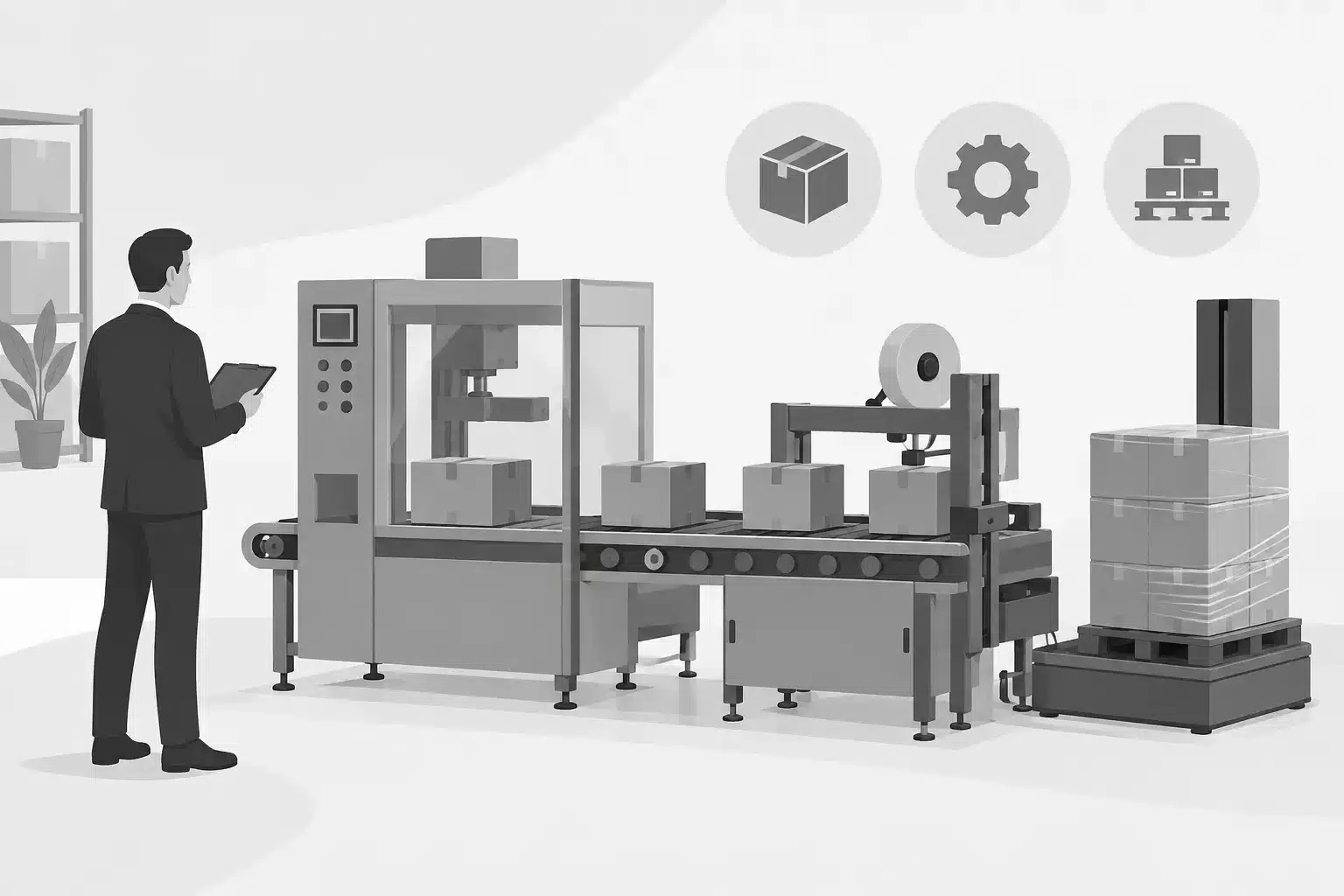
A packaging line can be filling accurately and still lose throughput at the end of the process. Bottlenecks often appear when products must be collated, cartoned, wrapped, packed into cases, inspected, and prepared for distribution. This secondary packaging equipment guide focuses on selecting machinery that protects output, fits the available line, and makes commercial sense.
Secondary equipment is not a single machine category. It is the group of systems that takes finished primary packages and converts them into retail-ready or shipping-ready units. The right configuration depends on product stability, pack pattern, production rate, changeover demands, warehouse requirements, and the condition of the equipment already installed.
What Secondary Packaging Equipment Does
Primary packaging places the product into its immediate container: a pouch, bottle, tray, blister, tube, jar, or bag. Secondary packaging groups, protects, identifies, or displays those finished units. A carton of bottles, a shrink-wrapped multipack, a tray of cans, and a corrugated case of pouches are all secondary packages.
For many plants, the practical objective is straightforward: move product from the primary machine to the palletizing area with minimal handling, controlled orientation, accurate counts, and dependable seals. That requires more than choosing a machine by nameplate speed. A cartoner that runs 150 cartons per minute may not support your required product infeed, carton style, insert placement, or changeover frequency.
The best purchase decision starts with the complete packaging flow. Consider how product enters the machine, how it is collated, what materials are used, where rejected product goes, and how the finished pack transfers downstream. Equipment that performs well in isolation can become a constraint when it is installed in a working line.
Start With the Pack and Production Requirement
Before comparing available machinery, define the pack you need to produce. Document product dimensions, weight, orientation, case count, carton or film specifications, and acceptable tolerances. Include the smallest and largest formats, not only the current best-selling SKU.
Line speed needs the same discipline. Specify normal operating speed, target speed, and the upstream machine’s realistic output. A filler or flow wrapper may run at a rated speed that is rarely achieved during daily production. Selecting downstream equipment solely around the highest theoretical number can create unnecessary capital cost and harder changeovers.
Ask these operating questions early:
- Does the product arrive continuously, intermittently, or in indexed groups?
- Is it rigid enough for side loading, top loading, or pushing into a carton or case?
- How many formats must run, and how often are changeovers performed?
- Does the application require coding, leaflet insertion, tamper evidence, weight verification, or metal detection?
- What utilities, footprint, guarding, and conveyor elevations are available?
The answers narrow the equipment search quickly. They also help determine whether a used machine can be adapted economically or whether a different configuration is the better decision.
Core Equipment Categories
Cartoners and Sleevers
Cartoners place products into folding cartons and close or seal the carton. Horizontal cartoners are commonly used for products that can be pushed or loaded sideways, including bags, flow-wrapped items, blisters, and certain consumer goods. Vertical cartoners suit products loaded from above, such as bottles, jars, pouches, or measured groups of items.
The key issue is not simply horizontal versus vertical. It is product handling. Look at infeed timing, flight spacing, carton magazine design, tuck or glue closure style, leaflet requirements, and discharge orientation. Established cartoner builders such as CAM, Langen, and ADCO are often attractive used-equipment options because replacement parts, technical familiarity, and proven mechanical designs can support long-term operation.
Sleevers apply a printed paperboard sleeve around a product or multipack. They can reduce material use compared with full cartons and provide strong shelf presentation. However, sleeve applications depend heavily on consistent product dimensions and reliable upstream collation. A variable product group can cause sleeve misalignment and frequent stoppages.
Shrink Wrappers and Multipack Systems
Shrink-wrap systems collate products and apply film for retail packs, transit packs, or bundled promotions. Configurations range from simple manual-feed systems to high-speed automatic wrappers with film handling, sealing, and heat tunnels. Texwrap and THS equipment are common names in many used-equipment searches.
Film choice matters as much as machine speed. Confirm the wrapper is suited to the film gauge, seal style, pack dimensions, and product temperature involved. Heat-sensitive products, irregular bundles, and formats with frequent changes may require additional testing before purchase. A wrapper that runs standard trays efficiently may not be appropriate for unsupported bottle packs or soft flexible products.
Tray Formers, Case Erectors, and Case Packers
Tray formers create corrugated trays or display-ready bases. Case erectors form and seal empty corrugated cases before products are loaded. Case packers load finished products into those cases using patterns that protect the product and use available cube efficiently.
Case-packing equipment can be top load, side load, wraparound, drop pack, or robotic, among other configurations. The right style depends on the product’s ability to tolerate handling and the desired case design. Side-load case packing can be efficient for stable, regularly shaped products. Top-load systems can be better for products that must remain upright or require gentler placement.
Do not treat the corrugated case as an afterthought. Case board grade, blank dimensions, glue pattern, and flap design affect performance. A machine proven on one case specification may need adjustment or new tooling for another.
Inspection and Verification Equipment
Checkweighers, metal detectors, vision systems, and reject devices protect quality and support compliance. Their position in the line matters. A checkweigher installed after cartoning verifies a different unit than one placed before cartoning. A metal detector may need to inspect individual packages before they enter a multipack, depending on the application and risk plan.
For used inspection equipment, confirm product dimensions, belt width, throughput, reject method, sensitivity requirements, data needs, and the availability of calibration or validation support. Pharmaceutical and food applications may have additional documentation requirements that influence what equipment is suitable.
Secondary Packaging Equipment Guide: Integration Checks
Most packaging problems occur at the handoff between machines. Product accumulation, conveyor speeds, transfer height, guide rails, and controls communication deserve the same attention as the main machine.
Start with the upstream and downstream interfaces. Confirm conveyor direction and elevation, product pitch, accumulation capacity, and who controls line stops. If an upstream machine faults, the secondary equipment should stop without creating product jams or damaging packaging materials. If a downstream case erector runs short of blanks, the case packer needs a controlled response.
Electrical standards also require review, particularly when equipment crosses borders or is being integrated into an existing North American line. Verify voltage, frequency, control components, safety circuits, guarding, and whether the equipment can meet site requirements without a major controls rebuild. Older equipment can be an excellent value, but only if the controls condition and supportability are understood before delivery.
Tooling is another common budget surprise. Format parts may include carton pockets, product flights, change parts, guides, star wheels, plows, mandrels, and case handling components. Ask which tooling is included and which formats it supports. A lower-priced machine without required format parts may cost more to commission than a better-equipped alternative.
Evaluating Used Equipment Without Guesswork
Used equipment can shorten lead times and reduce capital cost, but condition varies. The goal is not to buy the newest machine available. It is to buy a machine with the right mechanical condition, configuration, and support path for the job.
Review operating history where available, but do not rely on history alone. Inspect wear points, chains, belts, bearings, pneumatic components, vacuum systems, glue systems, heaters, drives, and guarding. Check whether the machine can be powered and demonstrated. For application-specific equipment, a trial with actual product and materials provides far more useful information than an unloaded cycle.
Documentation has real value. Electrical drawings, manuals, spare-parts lists, change-part records, and previous service information reduce startup risk. So does access to common components and experienced technicians. A recognized brand with accessible parts can be a better operating decision than an unfamiliar machine offered at a lower initial price.
Mectec Packaging Machinery sources and evaluates used packaging equipment with these practical factors in mind. For buyers with specific output, format, or application requirements, request-based sourcing can be more efficient than waiting for a general inventory listing to match the line.
Build the Purchase Around Uptime
The lowest acquisition price is not always the lowest cost of ownership. A machine that requires extensive retrofitting, unavailable parts, or frequent manual intervention can quickly consume the savings achieved at purchase. Conversely, a properly matched used cartoner, wrapper, case erector, or inspection system can add capacity without the lead time and capital burden of new equipment.
Keep the decision anchored to the product, the pack, and the production reality. When those three align, secondary packaging equipment becomes what it should be: a dependable part of the line that keeps finished goods moving.