

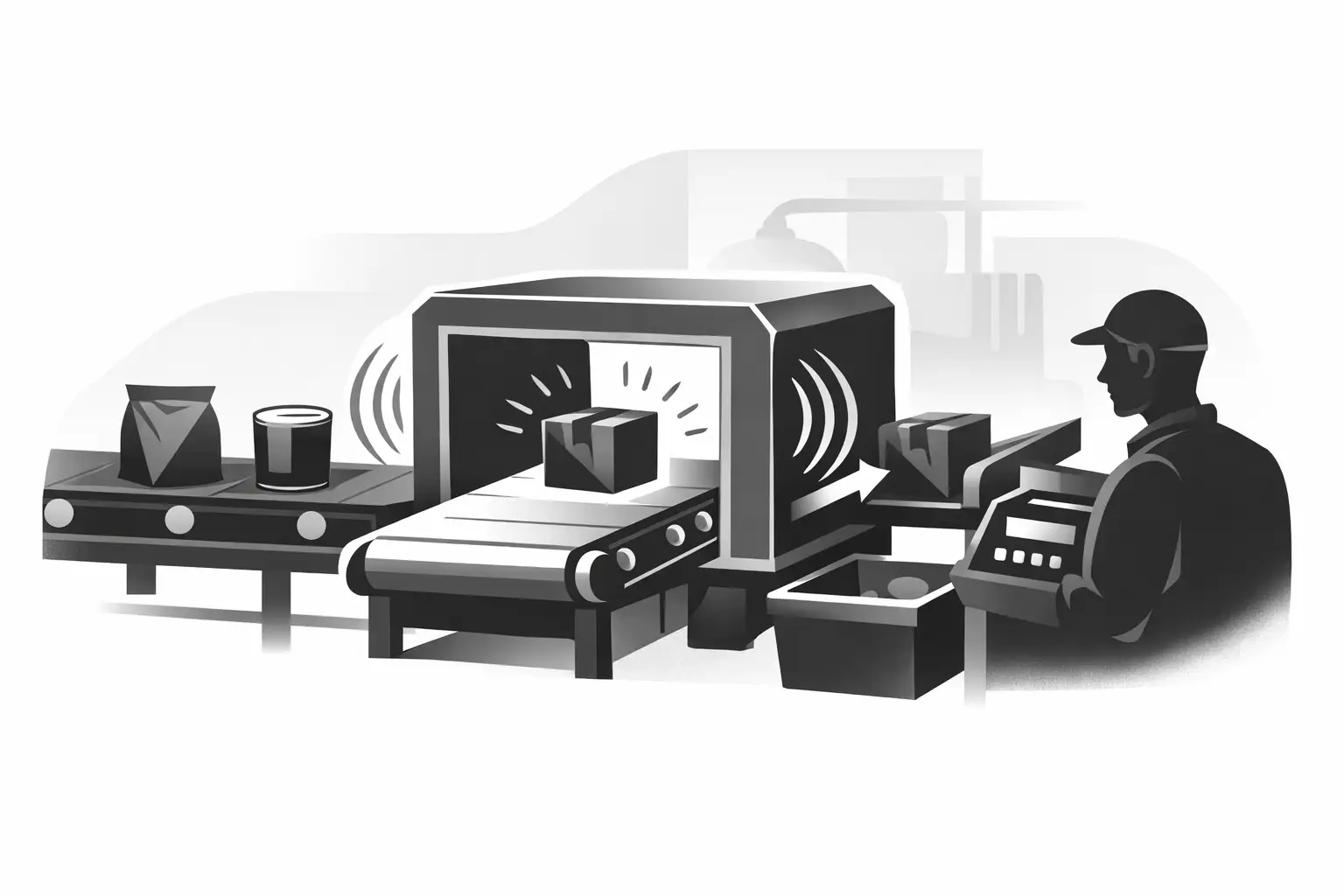
A metal detector that rejects a known test piece on a quiet production floor can still fail to deliver the required metal detector sensitivity once product, speed, vibration, temperature changes, and adjacent equipment are involved. For packaging-line operators, the question is not simply whether a detector works. It is whether it can consistently detect the required contaminant size in the actual product and package at the required throughput.
That distinction matters when specifying, evaluating, or purchasing a used industrial metal detector. Sensitivity affects product quality protection, customer requirements, audit readiness, reject rates, and line uptime. Set expectations too high without accounting for the application, and false rejects can become expensive. Set them too low, and the system may not provide adequate contaminant control.
What Metal Detector Sensitivity Actually Measures
Metal detector sensitivity is the smallest size of a particular metal contaminant that a system can reliably detect under defined operating conditions. It is commonly expressed as a test sphere diameter, such as 1.5 mm ferrous, 2.0 mm non-ferrous, or 2.5 mm stainless steel. Smaller numbers indicate greater sensitivity.
Those figures are useful, but they are not universal performance guarantees. A detector’s stated sensitivity is tied to the aperture size, product effect, orientation of the test piece, belt speed, inspection zone, and detector setup. A small ferrous sphere is generally easier to find than a similarly sized stainless steel contaminant. Stainless steel is often the limiting test material because its signal can be relatively weak.
For packaging operations, the practical specification should define three things: the contaminant types to be detected, the required detection level for each type, and the product conditions under which the detector must achieve that result. A dry pouch of powder, a foil-free snack bag, and a wet refrigerated tray pack may all require different equipment choices and expectations.
Why Sensitivity Changes on a Real Production Line
A metal detector creates an electromagnetic field around the product path. Metal passing through that field changes the signal. The challenge is that the product, package, and surrounding environment can also create changes that the detector must distinguish from a true contaminant.
Aperture Size Has a Direct Effect
The opening through which product passes is one of the most significant factors. A larger aperture reduces sensitivity because the product travels farther from the sensing coil. The general rule is simple: use the smallest practical aperture while maintaining safe clearance for the product and package.
This is often a key consideration with used equipment. A detector may be in excellent condition, but an oversized aperture selected for a previous package format can prevent it from meeting the sensitivity requirement for a new application. Conversely, a detector with a compact aperture may offer strong performance but be unsuitable for a taller case, tray, or bag.
The product should be centered in the aperture whenever possible. Off-center travel changes the relationship between the product and the detection field. Stable guides, consistent conveyor tracking, and controlled package spacing all support repeatable performance.
Product Effect Can Limit Detection Levels
Products with high moisture, salt, mineral content, or temperature variation can behave like a signal change within the detector. This is known as product effect. Meat, cheese, fresh produce, sauces, baked goods with variable moisture, and many pharmaceutical or chemical products may present this challenge.
Modern systems can compensate for product effect through appropriate frequency selection, phase analysis, and product setup. Still, compensation has limits. A detector should be evaluated using actual product at production conditions, not only an empty belt test.
Packaged products can add complexity. Metallized film, foil components, metalized labels, clips, and certain closures may require a different inspection approach. A conventional conveyor metal detector may not be the correct solution if the package itself creates a strong signal. Depending on the application, an advanced detector configuration, a different inspection point, or X-ray may be considered.
Speed, Vibration, and Electrical Noise Matter
Higher line speeds reduce the time a contaminant remains in the inspection field. A capable detector can handle fast production, but its performance must be proven at the intended speed, package pitch, and reject timing.
Vibration is another common source of instability. A conveyor frame that flexes, a reject mechanism that shakes the detector, or an adjacent machine with poor mechanical isolation can create signal variation. Electrical interference from variable-frequency drives, motors, poor grounding, and nearby control equipment can also affect performance.
A stable installation is part of the inspection system. During evaluation, look beyond the detector head and control panel. Review the conveyor condition, drive arrangement, belt tracking, reject device, guarding, and available line space. The best detector specification can be undermined by a poor installation.
Specifying Metal Detector Sensitivity for Your Application
Start with the risk and the production reality. A sensitivity target should align with your hazard analysis, customer specifications, product type, and packaging configuration. It should also be achievable without creating an unacceptable level of false rejects.
Provide a prospective equipment supplier with the product dimensions, package material, product temperature, moisture or salt characteristics, required throughput, conveyor height, and available footprint. If the detector will be installed after a checkweigher, cartoner, shrink wrapper, or case packer, identify that position clearly. Inspection before final packaging can offer better sensitivity, while inspection later in the line may better protect the finished shipment. The right choice depends on where contamination risk is highest and where rejected product can be handled properly.
For a useful evaluation, establish test standards before the machine is selected. Test pieces should reflect the metals of concern: ferrous, non-ferrous, and stainless steel. They should be passed through the detector in the product, through the center and appropriate edge positions, at normal line speed. The reject system should also be verified. Detecting a contaminant is only half the job. The system must remove it reliably, confirm the reject occurred, and prevent rejected product from returning to the line.
A complete acceptance test should confirm at least these operating conditions:
- Detection of specified ferrous, non-ferrous, and stainless steel test pieces.
- Testing with actual product, packaging, and normal product orientation.
- Reject timing and reject confirmation at the intended operating speed.
- Fail-safe response for low air pressure, full reject bin, detector fault, or reject verification failure.
Documented test results provide a clearer basis for a used-equipment purchase than a general statement that a detector is “high sensitivity.” The phrase has little value without the product and test conditions behind it.
Used Equipment: What to Inspect Before Purchase
Used metal detectors can offer a practical route to reliable inspection equipment, particularly when new-machine lead times or capital budgets are restrictive. The condition, configuration, and history of the complete system matter more than the detector head alone.
First, confirm the manufacturer, model, aperture dimensions, conveyor dimensions, controller generation, and available documentation. Established brands often have better access to service knowledge, replacement components, and trained technicians, but availability should be checked for the specific model. Older controls may still perform well, yet they may have limitations in data handling, user access control, validation functions, or supportability.
Inspect the physical system for belt wear, damaged rollers, frame corrosion, loose wiring, poor cable routing, and evidence of water ingress. Check whether the reject mechanism suits the product. A pusher, air blast, retracting belt, drop flap, or diverter must match package weight, stability, speed, and the available reject area.
Ask how the system was previously used. A detector handling dry, boxed product may not be configured for wet, conductive product. A unit from a washdown environment may have valuable stainless construction and ingress protection, but seals, connectors, and pneumatic components still require inspection. Previous service records and test documentation can be particularly valuable.
Mectec Packaging Machinery evaluates used packaging equipment with the operating application in mind. For buyers, that means matching detector aperture, conveyor layout, product conditions, and reject requirements before a machine is committed to the line.
Sensitivity Is Not the Only Performance Measure
The smallest detectable test sphere is a critical specification, but it should not be treated as the sole measure of system quality. A detector that is slightly less sensitive on paper but stable through normal production may deliver better control than a highly aggressive setting that causes repeated false rejects.
Repeatability is the real objective. Operators need a system that continues to detect specified contaminants across normal shifts, product changes, sanitation cycles, and expected environmental variation. Maintenance teams need access for cleaning, calibration checks, belt replacement, and reject-device service. Production teams need a detector that integrates without creating a recurring bottleneck.
When selecting equipment, specify the required performance first, then validate the machine against real product conditions. A properly matched used metal detector can protect product quality and keep the line moving. The right sensitivity is the level your system can prove, repeat, and maintain in production.