

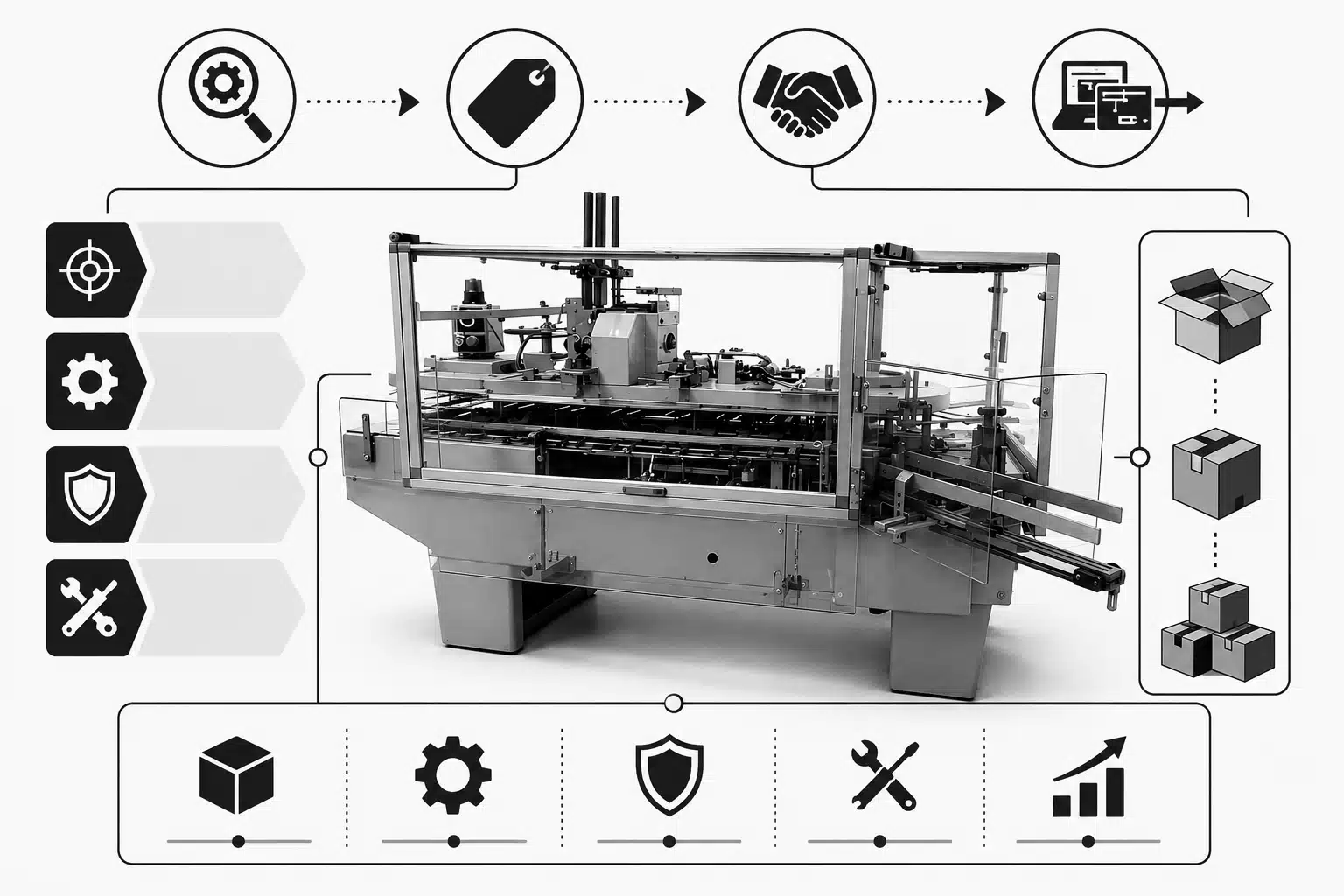
A used CAM AV65 vertical cartoner can be a practical route to added cartoning capacity when a new-machine lead time or capital cost does not fit the project. The model comes from a recognized cartoning brand and is suited to operations that need reliable erect, load, and close performance for vertical carton applications. But the model name alone is not enough. The right machine must match the carton, product, speed target, controls requirements, and physical layout of the line it will join.
For plant managers and procurement teams, the purchase decision should start with the application. A properly matched pre-owned cartoner can support dependable production at a lower acquisition cost. A poorly matched machine can create changeover delays, carton damage, integration work, and avoidable downtime.
Where a CAM AV65 Vertical Cartoner Fits
A vertical cartoner is generally used where the product is loaded from the top into an erected carton. Depending on its configuration and tooling, a CAM AV65 may be used for products such as bottles, jars, pouches, bags, trays, tubs, or grouped consumer goods. It can be relevant across food, personal care, pharmaceutical, nutraceutical, and consumer-product packaging operations.
The loading method matters. Some applications require manual product loading, while others rely on an infeed conveyor, collator, timing screw, pick-and-place system, or other automated product-handling equipment. Before reviewing a used CAM AV65 vertical cartoner, define how products arrive at the machine and how finished cartons leave it. The cartoner is only one part of the packaging line.
Carton style is equally important. Straight tuck, reverse tuck, glue closure, and specialty carton formats create different mechanical and tooling requirements. Carton dimensions, board quality, print finish, and tolerance also affect machine performance. A cartoner that ran one carton successfully in its previous plant may need format parts, adjustment, or a different setup to run another carton consistently.
Start With the Production Requirement
Speed claims should be treated as a starting point, not a purchasing decision. Maximum mechanical speed and sustained production speed are not the same. Actual output depends on carton quality, product presentation, loading method, operator involvement, and the number of planned format changes.
Document the required operating range before sourcing equipment. Include the smallest and largest carton dimensions, product dimensions, target cartons per minute, closure style, and whether inserts, leaflets, coupons, or multi-packs are involved. Also identify the expected percentage of time the line will run each SKU. A machine that performs well at a single high-volume format may not be the best choice for a facility with frequent short runs and multiple changeovers.
Plant conditions deserve attention as well. Confirm available electrical service, compressed air supply, floor space, guarding clearance, access for maintenance, and the machine’s place within the line. If the cartoner must connect to upstream filling or wrapping equipment and downstream case packing equipment, line height and conveyor orientation must be verified early.
What to Inspect on a Used CAM AV65 Vertical Cartoner
Used machinery should be assessed as a production asset, not simply as a lower-cost alternative. The goal is to understand what is included, what has been tested, and what work may be required before installation.
A meaningful equipment review should cover four areas:
- Mechanical condition: Inspect the carton magazine, erection section, transport chain, loading area, closing stations, drives, bearings, chains, belts, and safety guards. Look for wear that could affect carton control or repeatability.
- Electrical and controls condition: Confirm the control platform, operator interface, sensors, servo or drive components, electrical cabinet condition, and available documentation. Older controls can still be serviceable, but replacement parts and in-house maintenance capability should be considered.
- Format parts and change parts: Verify exactly which carton rails, buckets, guides, mandrels, folding components, and related change parts are included. Missing format parts can affect both budget and startup timing.
- Operational testing: When possible, evaluate the machine under power. A dry cycle confirms movement, but a run with representative cartons and products provides a more useful indication of real operating condition.
Machine history can add useful context, although it should not replace inspection and testing. Ask how the cartoner was used, why it was removed, whether it was stored indoors, and whether it was maintained during operation. A clean machine with a known production history is helpful. Verified functionality is more important.
Format Range Often Determines the Real Cost
The purchase price is only one line item. Format conversion can determine whether a used cartoner is a cost-effective fit or a project that consumes time and budget after delivery.
If the machine is already equipped with tooling for your carton size, the path is straightforward. If it is not, assess the availability and cost of conversion components before committing. This is particularly relevant for operations running narrow cartons, tall cartons, lightweight board, unusual flap configurations, or products that require specialized loading support.
Do not assume a listed format range guarantees compatibility. A carton may fall within the nominal dimensions but still present problems because of board stiffness, glue pattern, product overhang, leaflet placement, or closure requirements. Providing physical carton samples and representative product samples during the evaluation stage reduces uncertainty.
For multi-SKU operations, ask how the machine changes between formats. Some changeovers are primarily handwheel adjustments and guide changes. Others require more extensive component replacement and setup. The right answer depends on your production schedule. A slower conversion may be acceptable on a dedicated line, but it can become a constraint in a contract packaging or high-mix environment.
Plan the Integration Work Before Delivery
A cartoner performs best when it is integrated as part of a controlled packaging system. Upstream product flow needs to be stable, correctly spaced, and oriented for loading. Downstream equipment needs to accept the finished carton without backpressure that disrupts discharge.
Review the infeed and discharge configuration in detail. Determine whether existing conveyors can connect directly, whether transfers need to be fabricated, and whether line controls must exchange run, stop, fault, and accumulation signals. Include product reject requirements, code-date inspection, checkweighing, metal detection, serialization, and vision inspection where applicable.
Safety integration should be defined at the same time. Guarding, emergency stops, interlocks, lockout procedures, and operator access must suit the facility’s standards. If the machine is being moved between the United States and Canada, electrical and safety requirements should be reviewed before shipment rather than after installation.
Installation planning also affects uptime. Confirm who will position the machine, complete utilities, align conveyors, commission controls, train operators, and support initial production runs. The lower purchase cost of used equipment is valuable only when startup is organized and the machine reaches stable output quickly.
Buy for Supportability, Not Just Availability
Recognized brands such as CAM are often considered because maintenance teams may be familiar with their construction and packaging-line role. Still, the exact configuration matters more than the badge on the frame. A machine with accessible components, complete drawings, available change parts, and a known controls platform can be easier to support than a newer but poorly documented alternative.
It is also worth considering the spare-parts strategy at the time of purchase. Identify the wear items that should be held onsite, such as belts, chains, sensors, rollers, vacuum components, and carton-contact parts. If specialty parts are required, establish realistic lead times. This is standard planning for a production-critical cartoner.
Mectec Packaging Machinery helps buyers reduce the uncertainty around pre-owned equipment by sourcing, screening, and arranging tested packaging machinery for specific line requirements. For a CAM AV65 project, the useful conversation is not simply whether a machine is available. It is whether the available machine can run the required carton and product with a clear plan for formats, integration, and startup.
A Better Way to Evaluate Available Equipment
The strongest purchase process is sample-driven. Provide carton blanks, erected cartons, product samples, required output, current line layout, and details about any upstream or downstream machines. That information makes it easier to identify whether an available CAM AV65 is suitable as-is, requires change parts, or should be ruled out before time is spent on transport and installation planning.
A used cartoner should earn its place on the line through fit, condition, and supportability. When those three factors are confirmed early, a pre-owned CAM AV65 can be a disciplined capital decision that adds capable cartoning capacity without the uncertainty that too often follows an unverified used-equipment purchase.